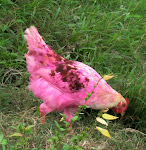
My bathhouse is a cement cube, with no roof, and with a groove along the base wall with an opening to let water drain out. So recently I have found this nice, tidy, pile of droppings strategically placed at the drain. Not sheep or goat, which are everywhere at my site, but kinda similar. Not quite rabbit pellets, either. The night screamer has been back, and locals tell me it looks like a small rabbit, which might be close. They say the screamer is nocturnal and lives in trees. So before it comes down at night to feed it sends out about 20 minutes of bloodcurdling screams, to scare away any predators that might be at the base of the tree. When I first came here it was just terrifying, but I got used to it, And he apparently moves around, because there will be weeks at a time when I don't hear it.
But I wondered about snakes. I've seen only two since I've been here, and they seemed kinda small compared to the size of the pile, but maybe. It's just so damned TIDY, I can't think of an animal so fastidious. Well, actually, we once had a Siamese cat that got locked in the house one day by accident. She very carefully pooped in the garbage disposer in the kitchen sink. But Siamese cats are not like any other animal I know. Needless to say, we didn't lock her in again.!
I'm promising one blog update a week until I leave here, which is in about nine weeks. So this one is short, but it's a start. And I'll have something more interesting next week. In the meantime, if you have any ideas about the mystery pooper, let me know.
Saturday, May 21, 2011

Saturday, March 26, 2011
Calendar update
When PCVs were working with students for the calendar competition they mostly worked with a few students in their class, a school club, etc. Because I went to so many different schools, and got so many entries, it was easy for me to spot work that was copied. When I got three identical versions of the same piece, I started asking questions, and learned that many students here don't see any difference between original art, a copy, or even a tracing. Many of the pieces that were submitted to me were copies of earlier HIV education materials. One young man did an identical piece of "original" work for himself and two of his friends, and one girl actually traced a picture of Cinderella in a coloring book - but she put a soccer ball in her hands. So I rejected anything that I was sure had been copied. The kids just didn't get it. "But Madahm, it is my hand that held the pencil, so it is my work!" "But it is not your vision, and it did not come from inside your brain." Round and round, but I held firm. If it was copied from an earlier poster, or a teaching manual, it was out.
So time went on, we finally got names of the winners and then the actual calendars. You can imagine my consternation when I saw that at least some of the winners submitted the same copied work that I had rejected! January was sort of a copy, but had enough new detail added that it seems OK. Same with April. July is not only flat-out copied, it might have been traced. Same with December. So I have calendars to distribute to the participating schools, and then the visits began. Students saw that someone won with the same work they had copied and I rejected! The head mistress at my winning student's school agreed that it is a problem she deals with over and over. But, she said, "Some times in Ghana when you do the right thing you make somebody angry." I assured her it was the same way in my country, but I still took a lot of flak. From an angry parent, an uncle who had paid for the photograph that accompanied work that was rejected, another parent, a weeping child, etc. A lot of unhappy campers, let me tell you. And I am sort of cranky, also, because some of the work I did turn in was much better than the copies that won...only nobody realized they were copies.
We were already talking about a different approach next year, so that a nine-year old girl isn't competing with a 20-year old guy, and hope to find a better way to handle the categories. And now this. I don't see any way we can memorize every piece of HIV info that's been published in Ghana over the years, but all the teachers agree that we should not accept work that is copied. Maybe just some sneaky interview with each student, along the lines of What a good idea, how did you ever think of that, etc., etc. But I won't be here for the next competition, so somebody else can wrestle with that one.
We had a similar problem with the applications for the GLOW camp last year. Each girl had to submit an essay about her best role model, and some of them were flat copied from somewhere else, like an encyclopedia, a news article, etc. One of the main purposes of the essay was to determine a girl's English skills; we didn't care about spelling or grammar so much as ideas and comprehension. So this year the essays will be written in the presence of a teacher, a PCV, etc. It sorta makes sense, because almost all teaching here is done by rote and in unison. An art teacher told me that when he gave the kids blank paper and said it was free time, they just sat there. "But you didn't tell me what to draw!"
So time went on, we finally got names of the winners and then the actual calendars. You can imagine my consternation when I saw that at least some of the winners submitted the same copied work that I had rejected! January was sort of a copy, but had enough new detail added that it seems OK. Same with April. July is not only flat-out copied, it might have been traced. Same with December. So I have calendars to distribute to the participating schools, and then the visits began. Students saw that someone won with the same work they had copied and I rejected! The head mistress at my winning student's school agreed that it is a problem she deals with over and over. But, she said, "Some times in Ghana when you do the right thing you make somebody angry." I assured her it was the same way in my country, but I still took a lot of flak. From an angry parent, an uncle who had paid for the photograph that accompanied work that was rejected, another parent, a weeping child, etc. A lot of unhappy campers, let me tell you. And I am sort of cranky, also, because some of the work I did turn in was much better than the copies that won...only nobody realized they were copies.
We were already talking about a different approach next year, so that a nine-year old girl isn't competing with a 20-year old guy, and hope to find a better way to handle the categories. And now this. I don't see any way we can memorize every piece of HIV info that's been published in Ghana over the years, but all the teachers agree that we should not accept work that is copied. Maybe just some sneaky interview with each student, along the lines of What a good idea, how did you ever think of that, etc., etc. But I won't be here for the next competition, so somebody else can wrestle with that one.
We had a similar problem with the applications for the GLOW camp last year. Each girl had to submit an essay about her best role model, and some of them were flat copied from somewhere else, like an encyclopedia, a news article, etc. One of the main purposes of the essay was to determine a girl's English skills; we didn't care about spelling or grammar so much as ideas and comprehension. So this year the essays will be written in the presence of a teacher, a PCV, etc. It sorta makes sense, because almost all teaching here is done by rote and in unison. An art teacher told me that when he gave the kids blank paper and said it was free time, they just sat there. "But you didn't tell me what to draw!"
Saturday, January 15, 2011
Small Victories
There has been a lot of HIV/AIDS education in Ghana, but there is still a lot of misinformation and stigma surrounding the entire topic. There have been cases where someone who tested positive went home and drank DDT because he believed his life was over. Others who tested positive and were open about their situation have been evicted from their homes, driven from their villages, etc. I even spoke with a pastor whose Christian congregation made him leave their church.
There is a US Presidential funding source for HIV education, and last year Peace Corps in Ghana developed a theme and had students around the country design posters or other art to promote that idea. They then chose twelve and published a calendar for 2010. This year the theme is MY FRIEND WITH HIV IS STILL MY FRIEND, and volunteers were asked to help spread that message as part of a national effort to reduce the stigma attached to the condition.
I went to the headmaster of a nearby school, and asked if he would be willing to let me speak to his students about HIV sometime. He called them all into an assembly on the spot, and I just started in. My intro was like, “your pastor, your teachers, and your parents have told you all the different ways you can contract HIV. Today I want us to talk about all the ways you WILL NOT contract HIV.” It was pretty successful, I thought, and the kids seemed interested and involved, but I figured they were also glad to get out of regular classes. However, before long other teachers and schools asked if I would come talk with their students.
Before it was over I spoke at nine schools, including public and private, Catholic and Muslim, with between 30 and 65 kids at each session. I had about a 30-minute talk, which was then translated by the teachers into Twi and Krobo, so the students heard the message several times. They were always quite shy at the beginning, but someone would ask the first question and we would then get into some pretty good discussions about playing, eating, and working together. Then I offered them the opportunity to design a poster for the 2011 calendar. Peace Corps provided the art supplies, and the first version was done with colored pencil and crayon. I got drafts from 82 kids! Last year each student who applied got top quality art supplies, but there was such a good turnout this time that PC let us submit and give poster paints and good quality art paper for only 10 entries. I chose what I thought were the 10 best, and each of those students then did a full-size poster that I submitted.
I don’t know how many students from all over Ghana submitted work with their local PCV, but it was well over 300. I was relieved that a committee in Accra had to make the final decisions, and it turned out that one of the students from my village won a place in the calendar on the month of May. His school is very proud, and for me it is one tangible thing I can look at. I often have to remind myself that whatever we can do, small-small, can make a difference.
The whole topic has some built-in dissonance. You want people to get tested, do the treatments, and live the best lives they can free of hassle and discrimination. The Ghanaian government supplies the anti-viral meds for only five Ghana cedis a month and there are good counseling services available. On the other hand, HIV is damn serious and you want everyone to recognize that fact and protect themselves in all the ways they have been taught.
There is a US Presidential funding source for HIV education, and last year Peace Corps in Ghana developed a theme and had students around the country design posters or other art to promote that idea. They then chose twelve and published a calendar for 2010. This year the theme is MY FRIEND WITH HIV IS STILL MY FRIEND, and volunteers were asked to help spread that message as part of a national effort to reduce the stigma attached to the condition.
I went to the headmaster of a nearby school, and asked if he would be willing to let me speak to his students about HIV sometime. He called them all into an assembly on the spot, and I just started in. My intro was like, “your pastor, your teachers, and your parents have told you all the different ways you can contract HIV. Today I want us to talk about all the ways you WILL NOT contract HIV.” It was pretty successful, I thought, and the kids seemed interested and involved, but I figured they were also glad to get out of regular classes. However, before long other teachers and schools asked if I would come talk with their students.
Before it was over I spoke at nine schools, including public and private, Catholic and Muslim, with between 30 and 65 kids at each session. I had about a 30-minute talk, which was then translated by the teachers into Twi and Krobo, so the students heard the message several times. They were always quite shy at the beginning, but someone would ask the first question and we would then get into some pretty good discussions about playing, eating, and working together. Then I offered them the opportunity to design a poster for the 2011 calendar. Peace Corps provided the art supplies, and the first version was done with colored pencil and crayon. I got drafts from 82 kids! Last year each student who applied got top quality art supplies, but there was such a good turnout this time that PC let us submit and give poster paints and good quality art paper for only 10 entries. I chose what I thought were the 10 best, and each of those students then did a full-size poster that I submitted.
I don’t know how many students from all over Ghana submitted work with their local PCV, but it was well over 300. I was relieved that a committee in Accra had to make the final decisions, and it turned out that one of the students from my village won a place in the calendar on the month of May. His school is very proud, and for me it is one tangible thing I can look at. I often have to remind myself that whatever we can do, small-small, can make a difference.
The whole topic has some built-in dissonance. You want people to get tested, do the treatments, and live the best lives they can free of hassle and discrimination. The Ghanaian government supplies the anti-viral meds for only five Ghana cedis a month and there are good counseling services available. On the other hand, HIV is damn serious and you want everyone to recognize that fact and protect themselves in all the ways they have been taught.
Saturday, July 10, 2010
More Thoughts on Slavery, Then and Now
What I said about our role in the industrialization of human misery is true, and the guilt is properly shared by Brits, Americans, and other Europeans. But I always thought it was Americans who put an end to it. Although I never believed that crap they taught us in school about states’ rights, I always thought it was our citizens, a combination of the Suffragists, Abe Lincoln, and a few pinko liberals in the North, who were determined to stop the human suffering. But not so. I recently learned it took the whole of Britain, at great personal and national sacrifice, to put an end to it. So this little piece is just an attempt on my part to be fair and historically accurate. According to Kristof and WuDunn, it was almost single-handedly a Brit named Thomas Clarkson, who was just doing a little research while a student at Cambridge. It was he who documented the actual implements of torture and gruesome restraint, and brought the information to the British public. Profiteers tried to have him killed, but he persevered and in a single decade the British people were so revolted by the facts that as a nation they demanded an end to the suffering. Britain banned the slave trade in 1807 and freed its slaves in 1833. France followed in 1848, and we as a nation eventually caught up.
In Half the Sky the authors also tell us that Saudi Arabia did not make slavery illegal until 1962, and Mauritania in 1981. Even if you are a teen ager now, and those dates seem waaay back, you should make them part of your basic history lesson. Maybe, as we internalize this stuff, we can find a path to make some changes in our own world. We can at least think about it.
In Half the Sky the authors also tell us that Saudi Arabia did not make slavery illegal until 1962, and Mauritania in 1981. Even if you are a teen ager now, and those dates seem waaay back, you should make them part of your basic history lesson. Maybe, as we internalize this stuff, we can find a path to make some changes in our own world. We can at least think about it.
The Slave Castle At Cape Coast
The castle is really grim, and it is almost as tough to write about it as it was to walk through it. We went there in March, but I’m still not able to tell you everything I saw and felt. Slavery has long been a part of human history; defeated warriors became slaves, the father asked his slave to prepare the Fatted Calf for the Prodigal Son, etc. The Greeks, the Romans, the Visigoths, and Native Americans all captured or held slaves and whatever women became the spoils of war. However, it took the Brits and the Americans to industrialize it, and the stain is with us still.
We had a terrific guide, a young Christian Ghanaian man, who was very professional and knowledgeable, and who never glossed over the fact that it was other Africans who raided villages and sold their kinsmen for the best price possible to the slavers. You can even visit another site where the prisoners were held and evaluated for strength and capability before being moved to the castle for the final sale. The guide’s professionalism slipped a bit, just once, when he talked about white men and women worshiping in a chapel they had built directly above the women’s dungeon. Somehow he was personally offended by that. Me too. But we all came out of the dungeon with such strong images that it was hard to blink in the daylight. A young black woman from the US wept openly, and I also would have but felt she was more entitled to her tears than I was to mine. Then the guide asked us to read an inscribed marble plaque at the exit. It asked us all to remember what we had seen, and to pledge that we would never permit such a thing to happen again. Ever. To anyone.
I couldn’t speak, because I knew that even as we read it a 12-year old girl was being pimped out of a 4-car garage in Southern California, a 9-year old was being molested by her father in Iowa, some parents somewhere in Asia were selling their prettiest daughter in order to buy food for the rest of the family, and other parents have locked their daughter in a small room until she agrees to marry her cousin. So it is happening, not again, but still; and we don’t really want to know, because we feel so helpless to change it. Please at least just think about it, and maybe our collective energy can fashion some kind of global change. The book, Half The Sky, by Nicholas Kristof and Sheryl WuDunn, is a bit hard to read at first, but it’s not sensationalistic and they do offer hope and some real strategies that could make a difference.
Back to the castle, being witness to such commercialism of pain and squalor is pretty tough. And I’m not saying that slavery was ever a good thing for any nation, so don’t be sending me any hate mail. But sometime later, when I was alone at home, I lit a candle to honor the ancestors. I wanted to celebrate the fact that they survived such horror, and to express my gratitude that because of their strength and courage their descendents, my black friends in America, are living where they are.
We had a terrific guide, a young Christian Ghanaian man, who was very professional and knowledgeable, and who never glossed over the fact that it was other Africans who raided villages and sold their kinsmen for the best price possible to the slavers. You can even visit another site where the prisoners were held and evaluated for strength and capability before being moved to the castle for the final sale. The guide’s professionalism slipped a bit, just once, when he talked about white men and women worshiping in a chapel they had built directly above the women’s dungeon. Somehow he was personally offended by that. Me too. But we all came out of the dungeon with such strong images that it was hard to blink in the daylight. A young black woman from the US wept openly, and I also would have but felt she was more entitled to her tears than I was to mine. Then the guide asked us to read an inscribed marble plaque at the exit. It asked us all to remember what we had seen, and to pledge that we would never permit such a thing to happen again. Ever. To anyone.
I couldn’t speak, because I knew that even as we read it a 12-year old girl was being pimped out of a 4-car garage in Southern California, a 9-year old was being molested by her father in Iowa, some parents somewhere in Asia were selling their prettiest daughter in order to buy food for the rest of the family, and other parents have locked their daughter in a small room until she agrees to marry her cousin. So it is happening, not again, but still; and we don’t really want to know, because we feel so helpless to change it. Please at least just think about it, and maybe our collective energy can fashion some kind of global change. The book, Half The Sky, by Nicholas Kristof and Sheryl WuDunn, is a bit hard to read at first, but it’s not sensationalistic and they do offer hope and some real strategies that could make a difference.
Back to the castle, being witness to such commercialism of pain and squalor is pretty tough. And I’m not saying that slavery was ever a good thing for any nation, so don’t be sending me any hate mail. But sometime later, when I was alone at home, I lit a candle to honor the ancestors. I wanted to celebrate the fact that they survived such horror, and to express my gratitude that because of their strength and courage their descendents, my black friends in America, are living where they are.
Dee Dub Is Tired and Cranky, July 3, 2010
But just barely amused. Yesterday I rode three hours on a rickety tro with no springs to interview some girls who have applied to attend our leadership camp. Just a few basic questions, and got mostly the same answers from all. Tell me some qualities that you think a leader needs to have. “Neatness, punctuality, and dependability.” Tell me one or two things you know about the United States. “Obama is president, and Ghana beat the US football team.” One girl also said she had heard that two men got married to each other? And had to go to court? But that probably isn’t true. Then three and a half hours back, on three different tros, and it’s the end of a long day. My backside does not have enough padding any more for such long rides in such dilapidated vehicles.
So today I want to just take it easy, and I am sick and tired of insects, goat poop on the porch, ants in my closet, warm beer, no electricity, petty village feuds that are just like office politics at home, and, mostly, sick and tired of kids. These kids have definitely taught me the difference between status and authority. I have lots of status here, and so does the kid who can talk me out of a biscuit, a pen, or an empty water bottle. However, I have absolutely no authority. None. Zilch. So no matter how many times I tell them not to go through the garbage, they do. If I catch them they run away laughing, but always come back. And there is nothing there they want, so they just leave it scattered all over the ground and the porch. I have fantasies about rattlesnakes, or mouse traps, or thoughts of botulism, etc. I know you are all proud of the work I am doing here, and especially the mature, adult ways I have learned to deal with conflict resolution. So you will be pleased to learn that I called an eight-year old boy an asshole. At the top of my lungs. And then threw the rest of the garbage on the ground and slammed the door. Way to go.
Talked to Colleen later, and she reminded me that at home scavengers go through their recycling, and then leave what they don’t want on the ground. And she often wants to shout that they are assholes, but it’s two am and she would have to get dressed and go outside so she just shines it. So all things are the same, and I giggled a lot while we were talking, and then it was late enough I let myself pour a glass of box wine and count my blessings.
July 4, 2010
Today is better. Last night I made a nice soup for dinner, and yesterday in the lorry station I actually found some fresh green beans. I am cooking them with some cocoa yam and bacon bits, so it smells sort of like the way my Texas grandmother cooked green beans, ham hocks, and potatoes. I think maybe I’m homesick, as well, but didn’t realize it. I am prepared for that at Christmas, Thanksgiving, and my children’s birthdays, but not the Fourth. Sometimes I do feel like such a stranger in a strange land, but it’s because EVERYTHING here is different, and I usually get over it. I remember spending July 4 in Paris alone, not the best way to be in Paris, ever, but I joined a bunch of strange Americans. Not weird strange, you understand, just travelers who were mostly unknown to each other. There was a restaurant that put on a little celebration for American tourists and ex-pats, and it was a nice way to spend some time. Another time I was in Peru at about 14,000 feet with some other American hikers, and we had some wine and a lot of laughs. Then last year, here in Ghana, I and some other trainees were at a tourist site at a small hotel at the top of a mountain. No wine, but the staff built us a bonfire and we sat around and told stories. Ghanaians don’t get the thing about bonfires. Everybody has a burn pile in their yard, and most people cook outside using wood or charcoal, so they don’t understand why we would waste wood just to sit and look at the flames. So ordinarily I wouldn’t be so nationalistic, or miss home on this particular day. But it’s Sunday morning, the church drums are really firing up, and I will go eat some distinctly American food. So Happy Fourth.
So today I want to just take it easy, and I am sick and tired of insects, goat poop on the porch, ants in my closet, warm beer, no electricity, petty village feuds that are just like office politics at home, and, mostly, sick and tired of kids. These kids have definitely taught me the difference between status and authority. I have lots of status here, and so does the kid who can talk me out of a biscuit, a pen, or an empty water bottle. However, I have absolutely no authority. None. Zilch. So no matter how many times I tell them not to go through the garbage, they do. If I catch them they run away laughing, but always come back. And there is nothing there they want, so they just leave it scattered all over the ground and the porch. I have fantasies about rattlesnakes, or mouse traps, or thoughts of botulism, etc. I know you are all proud of the work I am doing here, and especially the mature, adult ways I have learned to deal with conflict resolution. So you will be pleased to learn that I called an eight-year old boy an asshole. At the top of my lungs. And then threw the rest of the garbage on the ground and slammed the door. Way to go.
Talked to Colleen later, and she reminded me that at home scavengers go through their recycling, and then leave what they don’t want on the ground. And she often wants to shout that they are assholes, but it’s two am and she would have to get dressed and go outside so she just shines it. So all things are the same, and I giggled a lot while we were talking, and then it was late enough I let myself pour a glass of box wine and count my blessings.
July 4, 2010
Today is better. Last night I made a nice soup for dinner, and yesterday in the lorry station I actually found some fresh green beans. I am cooking them with some cocoa yam and bacon bits, so it smells sort of like the way my Texas grandmother cooked green beans, ham hocks, and potatoes. I think maybe I’m homesick, as well, but didn’t realize it. I am prepared for that at Christmas, Thanksgiving, and my children’s birthdays, but not the Fourth. Sometimes I do feel like such a stranger in a strange land, but it’s because EVERYTHING here is different, and I usually get over it. I remember spending July 4 in Paris alone, not the best way to be in Paris, ever, but I joined a bunch of strange Americans. Not weird strange, you understand, just travelers who were mostly unknown to each other. There was a restaurant that put on a little celebration for American tourists and ex-pats, and it was a nice way to spend some time. Another time I was in Peru at about 14,000 feet with some other American hikers, and we had some wine and a lot of laughs. Then last year, here in Ghana, I and some other trainees were at a tourist site at a small hotel at the top of a mountain. No wine, but the staff built us a bonfire and we sat around and told stories. Ghanaians don’t get the thing about bonfires. Everybody has a burn pile in their yard, and most people cook outside using wood or charcoal, so they don’t understand why we would waste wood just to sit and look at the flames. So ordinarily I wouldn’t be so nationalistic, or miss home on this particular day. But it’s Sunday morning, the church drums are really firing up, and I will go eat some distinctly American food. So Happy Fourth.
Dead Chicken, No Water June 19
Dead Fowl, No Water June 19
KB has come to help me work with my computer. The drillers have not returned, and we are wondering if another ceremony will be required when they do come. Sunday morning we find that the chicken is dead, and then we really wonder. Where you wait for transport is just outside the Presby Church and Kathryn is waiting to return to her site. When church is out we are talking with my counterpart and the committee chair, and the fetish priest joins us. All three assure us that nothing more is required when the crew returns to work. Everything is OK. KB says it’s certainly not OK for the chicken, the chicken is dead. Everybody laughs, but I explain to the priest that although we are laughing we recognize that what he does is serious. He then assures us that the fowl knew her role in the process and accepted it. I can certainly testify that seemed to be the case. During the course of several days she was tethered to a rock, then moved to a tree, to the porch out of the rain, and then to another rock. She scratched around in the dirt, but she never squawked, flapped her wings, or gave any sign of complaint. Interestingly enough, a dog that roams around the site sniffed her out a couple of times, but always wandered away. It seemed to me that the fowl was quite sanguine about the entire process, so don’t be calling the animal rights people, OK?
KB has come to help me work with my computer. The drillers have not returned, and we are wondering if another ceremony will be required when they do come. Sunday morning we find that the chicken is dead, and then we really wonder. Where you wait for transport is just outside the Presby Church and Kathryn is waiting to return to her site. When church is out we are talking with my counterpart and the committee chair, and the fetish priest joins us. All three assure us that nothing more is required when the crew returns to work. Everything is OK. KB says it’s certainly not OK for the chicken, the chicken is dead. Everybody laughs, but I explain to the priest that although we are laughing we recognize that what he does is serious. He then assures us that the fowl knew her role in the process and accepted it. I can certainly testify that seemed to be the case. During the course of several days she was tethered to a rock, then moved to a tree, to the porch out of the rain, and then to another rock. She scratched around in the dirt, but she never squawked, flapped her wings, or gave any sign of complaint. Interestingly enough, a dog that roams around the site sniffed her out a couple of times, but always wandered away. It seemed to me that the fowl was quite sanguine about the entire process, so don’t be calling the animal rights people, OK?
June 29 update
I am learning more about how all this works, but the drillers started in another spot on Sunday and today they took their equipment off to another job. They have not found water. They will have their hydro-geologist come back to site and do another analysis, and then they will return. It is the geologist who failed them, not the fetish priest. They began this job without the proper rituals, and it was for this reason the earth seized their drill pipe and broke it off underground. After he did the appropriate libations, they were able to remove the broken pipe from the ground and resume drilling. The fact that they did not find water is because the geologist did not point them to the right spot, and has nothing to do with the need for libations. However, after the geologist does another analysis, and they return with the drilling equipment, we will pour more libations before they begin work. That’s really just a precautionary measure, but I will insist on it.
It seems that this village is actually located between two rivers. The smaller one, down the hill to the northwest, is protected by a goddess who cares for the women in the village. Because of her concern she always releases enough water that they can do their work and take care of their families as they have always done. (But that was before giant poly tanks entered the picture.) The larger river is up the hill on the other side of the road, deeper in the forest. It is that river that feeds the groundwater supply, and it is guarded by a male god who is very concerned about what is happening to the environment. He is particularly disturbed that mineral deposits are being moved around and depleted, and is reluctant to let just anybody come in here and do whatever they want in his domain. It was probably he, or one of his lesser gods, who seized the pipe as a small warning to the villagers to do this properly. And I’m with him. A few months ago I visited a small village where a company is mining for gold on the surface. You could see the chemicals, including arsenic and cyanide, going right into the small river and then seeping through to the groundwater supply. The chief of that village knows what is happening, but has brushed away the concerns of a few obrunis who always seem to worry about something that is not their concern.
So we will wait for the geologist to do his work, the fetish priest will then do his, and when the drillers return they will find water. My friend has another bottle of lavender scent that she has offered to donate to the cause if we need it. I also bought some lavender silk flowers (made in China) that we can use as well, so I think we have it covered. Will keep you posted.
Tuesday, June 29, 2010
Ann's Visit to Ghana: Cape Coast
This was the last leg of my journey in Ghana. On Good Friday, April 2, I awoke at about 5am to the sound of drums from the nearby churches. We had coffee and packed up to go to Cape Coast. Patience helped carry our bags down the hill to the taxi station where we caught a taxi to Osien. We then caught a Tro to Koforidua and transferred to a Tro to Asamankase. Beyond that point, we weren't sure where we needed to go next, but the driver told a young man to take our bags to another station because we wanted to go to Cape Coast. I went and bought tickets to Agon Swegwu. We weren't absolutely sure we were on the right Tro, but my compass indicated that we were headed in the right general direction. Unfortunately, DeeDub discovered that she no longer had her cell phone. There had been some jostling around with people getting on and off the Tro, so she may have dropped it, or someone might have stolen it. At Agon Swegwu we got on a more traditional bus that we knew was headed for Cape Coast. From there we were obviously in a more developed, more tourist oriented area than I had been in up until then.


 We soon realized that most of the fleet was located at the foot of Cape Coast Castle; a place that had been recommended to me by Kathy Moroney at Distinctive Destinations in Sacramento, California. http://www.distinctive-destinations.com. By the way, Kathy was enormously helpful to me in preparing for this trip.
Cape Coast Castle was one of the largest slave-holding sites in the world during the colonial era. It is a fascinating place to visit, but you can also see a lot of videos on YouTube that people have posted.
 So, even though it was already incredibly hot and humid, we decided to take the tour. This a model that
shows the layout.


There are three dungeons where people were held in the most horrible conditions. They were dark, dank and totally stifling. The guide turned off the lights so we could get a sense of what it must have been like. I couldn't get a picture that really captured how awful it was.

Slaves were herded through "The Door of No Return" down to the beach where they were loaded onto canoes, probably not a lot different from the fishing canoes. Then they were taken to ships anchored off shore in which they would be taken to the Americas and resold. This was an amazing experience and profoundly moving.


After taking a nap, we went to dinner at the Oasis Beach Hotel, which was the most tourist-like place I'd been to in Ghana. It reminded me of Jamaica. The next morning we took a taxi to Kakum, a national park where you walk on suspended bridges in the jungle canopy. The tours were a bit rushed and I understand you can arrange for early tours that would likely be more interesting: more time to look around and perhaps see birds and monkeys that were certainly not visible when we were among a large group of tourists.
I started this draft in May and am just finishing it on June 29. I should not have waited so long; it's all that much more distant. However, I still think and dream about my trip and am so glad that I went. It was a huge adventure and one that DeeDub lives every day!
Sunday, June 20, 2010
Dee Dub and the Fetish Priest Tuesday, June 15th
Several worried villagers arrive at 6:30 am to tell me the problem is not with the pipe. The problem is that we did not do the proper ritual before we began the work, and they will never find water until we rectify the situation. The fetish priest has told them he will perform the necessary ceremony if we give him 450 ghana cedis, a fowl, a bottle of schnapps, and lavender. Someone explains the lavender must be six blossoms. The committee chair, Mr. B, is a Christian and an officer in the local Presbyterian Church, but he says we must follow the local custom. If we don’t, and they don’t find water, then the
villagers will blame us. The shaman, Mr. M, arrives, there is much negotiation, and he finally agrees to 250 cedis. Everybody says the contractor must pay the money, because he should never have started the work without the proper libations being poured. I call Mr. A, owner of the company, who says he is a serious Christian and “…doesn’t hold with that stuff.” Just let him know when his men can come back to work.
Then everybody agrees that the NGO must pay the money. They had this same problem with another bore hole a couple of years ago, and the NGO paid then and should have known they would have to pay this time. I call Alex, the NGO rep who is working with me on this project. He says absolutely not, no way, no how. They have never paid for magic, and they never will. The villagers say not so, Mr. L, another NGO rep, has always paid the fetish priest for the seven years they were doing work here, but never told the NGO director. I ask Alex to check with Mr. L. Alex calls back, to say well, ok, but they’ve never paid more than 100 cedis (and this is all news to him). The NGO director authorizes 100 cedis, we hand over some money, the schnapps, and the fowl, but are stuck on the lavender. I have a spray bottle of lavender that a friend brought back from Rome, that I use when stuff in the closet gets just too musty. We spray me, the priest, everybody else, and I point out that it was made from real lavender in Europe, and he decides it will work. He will do the ritual at midnight tonight (Tuesday) and the crews can come back to work tomorrow. We’ll see, and that will be the next update.
villagers will blame us. The shaman, Mr. M, arrives, there is much negotiation, and he finally agrees to 250 cedis. Everybody says the contractor must pay the money, because he should never have started the work without the proper libations being poured. I call Mr. A, owner of the company, who says he is a serious Christian and “…doesn’t hold with that stuff.” Just let him know when his men can come back to work.
Then everybody agrees that the NGO must pay the money. They had this same problem with another bore hole a couple of years ago, and the NGO paid then and should have known they would have to pay this time. I call Alex, the NGO rep who is working with me on this project. He says absolutely not, no way, no how. They have never paid for magic, and they never will. The villagers say not so, Mr. L, another NGO rep, has always paid the fetish priest for the seven years they were doing work here, but never told the NGO director. I ask Alex to check with Mr. L. Alex calls back, to say well, ok, but they’ve never paid more than 100 cedis (and this is all news to him). The NGO director authorizes 100 cedis, we hand over some money, the schnapps, and the fowl, but are stuck on the lavender. I have a spray bottle of lavender that a friend brought back from Rome, that I use when stuff in the closet gets just too musty. We spray me, the priest, everybody else, and I point out that it was made from real lavender in Europe, and he decides it will work. He will do the ritual at midnight tonight (Tuesday) and the crews can come back to work tomorrow. We’ll see, and that will be the next update.
Work Begins on The Bore Hole! Friday, May 28, 2010
They brought their equipment in yesterday afternoon, and started work this morning! Dozens of villagers come and sit for hours watching them work. The chief is being installed tomorrow, but they say they will continue to work. Even if there is a lot of traffic and activity down the hill in the village proper, they will be here. The NGO is still adamant that there will be no submersible pump, and the women must continue to carry water up the ladder to fill the polytank. The chief says we must trust the NGO, they know what is best for us. Just another form of colonialism as far as I am concerned, but nobody wants to go against their chief. The committee members are thrilled to see the work begin, and so am I.
The owner of the drilling company has assured me privately that he knows how to get around these NGOs, and there WILL be a pump. Says he has heard what good work the committee and I are doing, and he will be sure we get what we need. I’m not sure how that will work, but I’m really glad to hear it. I think he is a really good guy, I trusted his information a lot during the struggle to find a contractor, and I was really glad when they gave him the contract. (I heard that the NGOs reluctance about him was because they thought I was getting a kickback! They call it chop here, and it’s so common that it’s a regular part of the Ghanaian mindset.)
Big Delays on the Bore Hole! Tuesday. June 1.
One of the pipes has broken off in the ground, and they can’t get it out. They must wait for a different kind of pipe to come from the factory, so they pull their equipment off to another job. I think they are probably just juggling worksites, which happens routinely with contractors at home, so I am not too concerned. Mr. A, the owner, assures me it won’t be too long before the stuff they need arrives from the factory, and they will drill until they reach “ancient water”.
Monday, June 14.
Mr. A says his crews will return Tuesday evening or Wednesday morning. He assures me they will install the underground plumbing to the two poly tanks, so there will be no need to retrofit. He also tells me not to worry, that everything will be the way we want it.
The owner of the drilling company has assured me privately that he knows how to get around these NGOs, and there WILL be a pump. Says he has heard what good work the committee and I are doing, and he will be sure we get what we need. I’m not sure how that will work, but I’m really glad to hear it. I think he is a really good guy, I trusted his information a lot during the struggle to find a contractor, and I was really glad when they gave him the contract. (I heard that the NGOs reluctance about him was because they thought I was getting a kickback! They call it chop here, and it’s so common that it’s a regular part of the Ghanaian mindset.)
Big Delays on the Bore Hole! Tuesday. June 1.
One of the pipes has broken off in the ground, and they can’t get it out. They must wait for a different kind of pipe to come from the factory, so they pull their equipment off to another job. I think they are probably just juggling worksites, which happens routinely with contractors at home, so I am not too concerned. Mr. A, the owner, assures me it won’t be too long before the stuff they need arrives from the factory, and they will drill until they reach “ancient water”.
Monday, June 14.
Mr. A says his crews will return Tuesday evening or Wednesday morning. He assures me they will install the underground plumbing to the two poly tanks, so there will be no need to retrofit. He also tells me not to worry, that everything will be the way we want it.
Vision Questors and Emergency Travelers June 8, 2010
Two newbie Peace Corps Trainees (PCTs) came to spend five days at a working site, mine. They had been in country all of five days, and got here on their own via public transportation. Tro-tros, shared taxis, etc. So they got here early afternoon, and we walked around the village, brought home cold beer, had a proper dinner, and made an early night of it. They probably hadn’t had a full night’s sleep since they got here. Next day Grace, a runner who has done several marathons, ran early morning, while it was cooler, but she was followed by a whole parade of kids who were fascinated. Then we went to a nearby market town, checked out the (stone-age) internet café, ate Ghanaian food at a chop bar, and got totally soaked by a sudden rain. In bed by nine, but remember it’s dark here by 6:15.
So my cell phone rings at 10:30, which seems like the middle of the night, and Osa is calling to tell me I have a visitor. He is bringing the visitor up the hill. I’m thinking it’s some crazy friend who came to surprise me (I can always hope), but it is five women loaded down with produce and other market goods. They had purchased goods at a village beyond us, on a very treacherous road, and were on their way to Accra when their vehicle lost its steering and went over the side. They made their way, carrying all the market goods, a couple of kilometers to town, where someone took them to Osa who then brought them to the guest house. Great hubbub on the porch outside the room where the newbies were sleeping. The women were telling Osa what happened, and he was translating for me in English, but everybody was very voluble and Osa kept saying how lucky they were to be alive. It was Grace that saved them, he kept saying, great Christian that he is. Only by Grace are they alive, and etc. Meanwhile PCT Grace, who doesn’t understand any of this, hears a lot of shouting and hears her name over and over. She is afraid she has broken some taboo of the village and they have come to complain. She ran in shorts, could that be it? Maybe she said something wrong to one of the children? Osa and I scramble around to get mattresses so they can share one room; they were pretty traumatized and didn’t want to be separated. And probably had enough money for only one room, since they were on their way TO market, not from. But we finally have them settled in for the night, and the newbies creep out to find out what was going on. Great confusion, many explanations, and much laughter. Poor Grace, however, has pumped so much worry-induced adrenaline that she can’t get back to sleep, the roosters start right on time, and soon it’s time to get started on the rest of the quest.
We go to the Bead Market in Kofaridua, visit the living quarters of another PCV and another village where jewelry is made from the beads, have chicken and real vegetables for late lunch, and call it a day. (But it was a 15-hour day, at least, and all done on tros.) Next day they did bucket laundry, some Peace Corps home work, and Osa took them on a three-hour Cocoa Tour. Everybody got overheated, which only confirmed their love for the bucket bath. Patience made us a splendid dinner of Ghanaian recipes that Westerners like, and the next day they headed out on their own to make their way to the PC Training Hub in Kukurantumi.
So my cell phone rings at 10:30, which seems like the middle of the night, and Osa is calling to tell me I have a visitor. He is bringing the visitor up the hill. I’m thinking it’s some crazy friend who came to surprise me (I can always hope), but it is five women loaded down with produce and other market goods. They had purchased goods at a village beyond us, on a very treacherous road, and were on their way to Accra when their vehicle lost its steering and went over the side. They made their way, carrying all the market goods, a couple of kilometers to town, where someone took them to Osa who then brought them to the guest house. Great hubbub on the porch outside the room where the newbies were sleeping. The women were telling Osa what happened, and he was translating for me in English, but everybody was very voluble and Osa kept saying how lucky they were to be alive. It was Grace that saved them, he kept saying, great Christian that he is. Only by Grace are they alive, and etc. Meanwhile PCT Grace, who doesn’t understand any of this, hears a lot of shouting and hears her name over and over. She is afraid she has broken some taboo of the village and they have come to complain. She ran in shorts, could that be it? Maybe she said something wrong to one of the children? Osa and I scramble around to get mattresses so they can share one room; they were pretty traumatized and didn’t want to be separated. And probably had enough money for only one room, since they were on their way TO market, not from. But we finally have them settled in for the night, and the newbies creep out to find out what was going on. Great confusion, many explanations, and much laughter. Poor Grace, however, has pumped so much worry-induced adrenaline that she can’t get back to sleep, the roosters start right on time, and soon it’s time to get started on the rest of the quest.
We go to the Bead Market in Kofaridua, visit the living quarters of another PCV and another village where jewelry is made from the beads, have chicken and real vegetables for late lunch, and call it a day. (But it was a 15-hour day, at least, and all done on tros.) Next day they did bucket laundry, some Peace Corps home work, and Osa took them on a three-hour Cocoa Tour. Everybody got overheated, which only confirmed their love for the bucket bath. Patience made us a splendid dinner of Ghanaian recipes that Westerners like, and the next day they headed out on their own to make their way to the PC Training Hub in Kukurantumi.
Update for June 20, 2010
Because I write this stuff sometimes and can’t get to the internet, I am posting several today. I hope. So they will be new, but should have a title and a date so you know what you’re reading. Hope it all works. Cheers, dw
Back to Nature April 2010
It may be that the wonderful feelings we experience about that nature connection are a Western luxury. Wasn’t there a guy, maybe Maslow, who said you can’t appreciate nature, or any other kind of beauty, until your other needs are met? I sort of remember a triangle, with food, sex, shelter, comfort, etc., tapering up to the top. But I always thought he missed the point, because the cave paintings to me represented a basic need for art that I think is universal. My time here in Ghana has made me re-examine all of that. I was immediately surprised by the lack of landscaping, color, etc., in a place where I expected to see a profusion. Maybe I expected it to be more like Jamaica, based on climate, British colony, etc., But it’s not. (On the other hand, because of that British influence I expected good gin, excellent tea, and tonic water. Not happening here.)
It may be cultural, but I just can’t figure it out. For about seven to 10 minutes at a certain time in some evenings, the light changes everything into this luminous glow that is like nothing I have seen. And I thought the violet glow from the sun setting behind Haleakala was as good as it gets. There are sometimes sunsets visible from my porch that just take my breath away, but people don’t understand what I am excited about. There is also their curiosity about my home, and they sometimes overlap. For example, a genuine question, Do you not have sunsets in your country? And, Is this moon the same one you see at home? There is a huge lack of knowledge about just basic geography, but there seems to be something else in play as well.
Some of the Peace Corps art teachers have given a good example. They announce this is individual or independent art time, give a kid blank paper and paint or colored pencils, and wait for the result. There is none. The kid explains, but you didn’t tell me what to draw. Our teachers are absolutely the best, and they are making changes and modeling different ways, but they have all commented on the same experience.
Since I have been at site I have seen few if any birds or butterflies, but that is changing with the season. I recently saw eight butterflies in one day, and each of them was spectacularly different from the others. And there are now more than 100 small yellow birds in one palm tree outside my front door at six every morning. I just stand and gawk, and people going to fetch water ask what I am doing. I point out the birds, and the response is a Ghanaian version of, “Yeah. So what’s your point?” And the last two weeks I have seen things starting to bloom, so there are big swaths of color where there were just various shades of green.
I get letters from hikers at home about the fall colors, or from kayaking friends about being on the delta with the herons, and I get a visceral kind of jealousy. It’s not that there isn’t beauty here, there is, but maybe there’s just no one to share it with. In the way we would share at home, as we both or all experience one of those moments. A single heron, or a flock of geese heading south, or the way the trees on some Sacramento streets explode with beauty in the spring and fall. I remember when I was on campus, I would have a severe attack of hyper-aesthesia at the way the fall colors blended with each other as I walked the quad.
Maybe this business about being one with nature is hard to get to if the regular experience is one where you are losing. The ants, the termites, the mosquitoes, the house that’s melting in the rain, the crop that is failing because now there is no rain, etc. I know at home we think farmers have a special bond to the land, and I still think so…even in the days of agri-business, but the guy picking grapes for minimum wage may not think so. I just don’t know. But I wish you were here, and we could have a real conversation about it all.
When Christo wrapped a lot of the Napa Valley in white parachute silk, I took Kelley out of school and we drove to see it the last week when they were taking it down. We were stopped on a dirt road at the end of a long driveway, and the farmer walked down to get his mail. He was a lot like my dad, dark from the fields, not very communicative, eyes taking in everything. We howdied and shook, and I asked what he thought of the fence. He had started back up the drive, but he turned around and said, “Well, I thought it was pretty stupid.” Long silence, then , “But I sure am gonna miss it when it’s down.”
Enough for today. The whole point of a blog is to be here now, not come back and edit, and polish, etc. Have a good day. And enjoy the sunset.
It may be cultural, but I just can’t figure it out. For about seven to 10 minutes at a certain time in some evenings, the light changes everything into this luminous glow that is like nothing I have seen. And I thought the violet glow from the sun setting behind Haleakala was as good as it gets. There are sometimes sunsets visible from my porch that just take my breath away, but people don’t understand what I am excited about. There is also their curiosity about my home, and they sometimes overlap. For example, a genuine question, Do you not have sunsets in your country? And, Is this moon the same one you see at home? There is a huge lack of knowledge about just basic geography, but there seems to be something else in play as well.
Some of the Peace Corps art teachers have given a good example. They announce this is individual or independent art time, give a kid blank paper and paint or colored pencils, and wait for the result. There is none. The kid explains, but you didn’t tell me what to draw. Our teachers are absolutely the best, and they are making changes and modeling different ways, but they have all commented on the same experience.
Since I have been at site I have seen few if any birds or butterflies, but that is changing with the season. I recently saw eight butterflies in one day, and each of them was spectacularly different from the others. And there are now more than 100 small yellow birds in one palm tree outside my front door at six every morning. I just stand and gawk, and people going to fetch water ask what I am doing. I point out the birds, and the response is a Ghanaian version of, “Yeah. So what’s your point?” And the last two weeks I have seen things starting to bloom, so there are big swaths of color where there were just various shades of green.
I get letters from hikers at home about the fall colors, or from kayaking friends about being on the delta with the herons, and I get a visceral kind of jealousy. It’s not that there isn’t beauty here, there is, but maybe there’s just no one to share it with. In the way we would share at home, as we both or all experience one of those moments. A single heron, or a flock of geese heading south, or the way the trees on some Sacramento streets explode with beauty in the spring and fall. I remember when I was on campus, I would have a severe attack of hyper-aesthesia at the way the fall colors blended with each other as I walked the quad.
Maybe this business about being one with nature is hard to get to if the regular experience is one where you are losing. The ants, the termites, the mosquitoes, the house that’s melting in the rain, the crop that is failing because now there is no rain, etc. I know at home we think farmers have a special bond to the land, and I still think so…even in the days of agri-business, but the guy picking grapes for minimum wage may not think so. I just don’t know. But I wish you were here, and we could have a real conversation about it all.
When Christo wrapped a lot of the Napa Valley in white parachute silk, I took Kelley out of school and we drove to see it the last week when they were taking it down. We were stopped on a dirt road at the end of a long driveway, and the farmer walked down to get his mail. He was a lot like my dad, dark from the fields, not very communicative, eyes taking in everything. We howdied and shook, and I asked what he thought of the fence. He had started back up the drive, but he turned around and said, “Well, I thought it was pretty stupid.” Long silence, then , “But I sure am gonna miss it when it’s down.”
Enough for today. The whole point of a blog is to be here now, not come back and edit, and polish, etc. Have a good day. And enjoy the sunset.
Update to Nature, Late May
Things do bloom here after all, and it is wonderful. Even the plain green stuff has new growth of brighter crisper green, and there are blossoms in trees and plants that I thought were dead. The rainy season isn’t here yet, but it’s on its way. The nights are really sticky hot and new insects are making themselves known. But so are birds, and butterflies, and millions of baby chicks. They are so adorable when you watch them follow the mom around and learn how to scratch for food; but then you just turn around and they’ve turned into teenagers, and they leave their mess all over the front porch, and make noise when you’re trying to sleep. And baby goats! They wrestle each other like puppies, roll around, charge after each other, butt heads, etc. And so many different markings I have never seen. Pinto goats, striped goats, grey speckled goats, etc. There are some brown ones with sorta pointy ears, and once in a while I will see one almost hidden behind a shrub and for a split second it’s a deer and I’m back in Volcano. Doesn’t happen often, but it’s a trip.
There are lambs as well, but the sheep here are big with really long skinny legs and look more like ponies than the sheep we know. Their wool is more like dreadlocks that have never been groomed, and some are black with that really bad henna job on the ends. Not good. And they lose each other all the time so they are constantly crying for a mom, or a baby. Not like those cuddly things in the hills around Stinson. And somehow I don’t think I would ever want to eat one of these, although I have no compunctions at home. I remember when we would be driving to the Coast, and Sheila would get all mooney, and “Oh, nushka, look at the babies!” and Annie and I would go, “Right. Let’s eat ‘em!” Not here, but I have learned to make a good pasta sauce from tinned mutton. The food nazi in retreat.
Early one morning though, when I was at the beach, I saw a man washing a flock of sheep in the ocean. One guy kept the rest of the flock off to one side, and the other man would pick up a big sheep and carry it out into the deep waves. Some were fairly passive, but some really struggled to avoid the water. There was no stopping him, he was big and strong, and he kept each one up to its neck in salt water for a really long time while he washed away at it. Go figure.
Saturday, April 24, 2010
Ann's Visit to Ghana: Maasse, KwakuSae, Koforidua
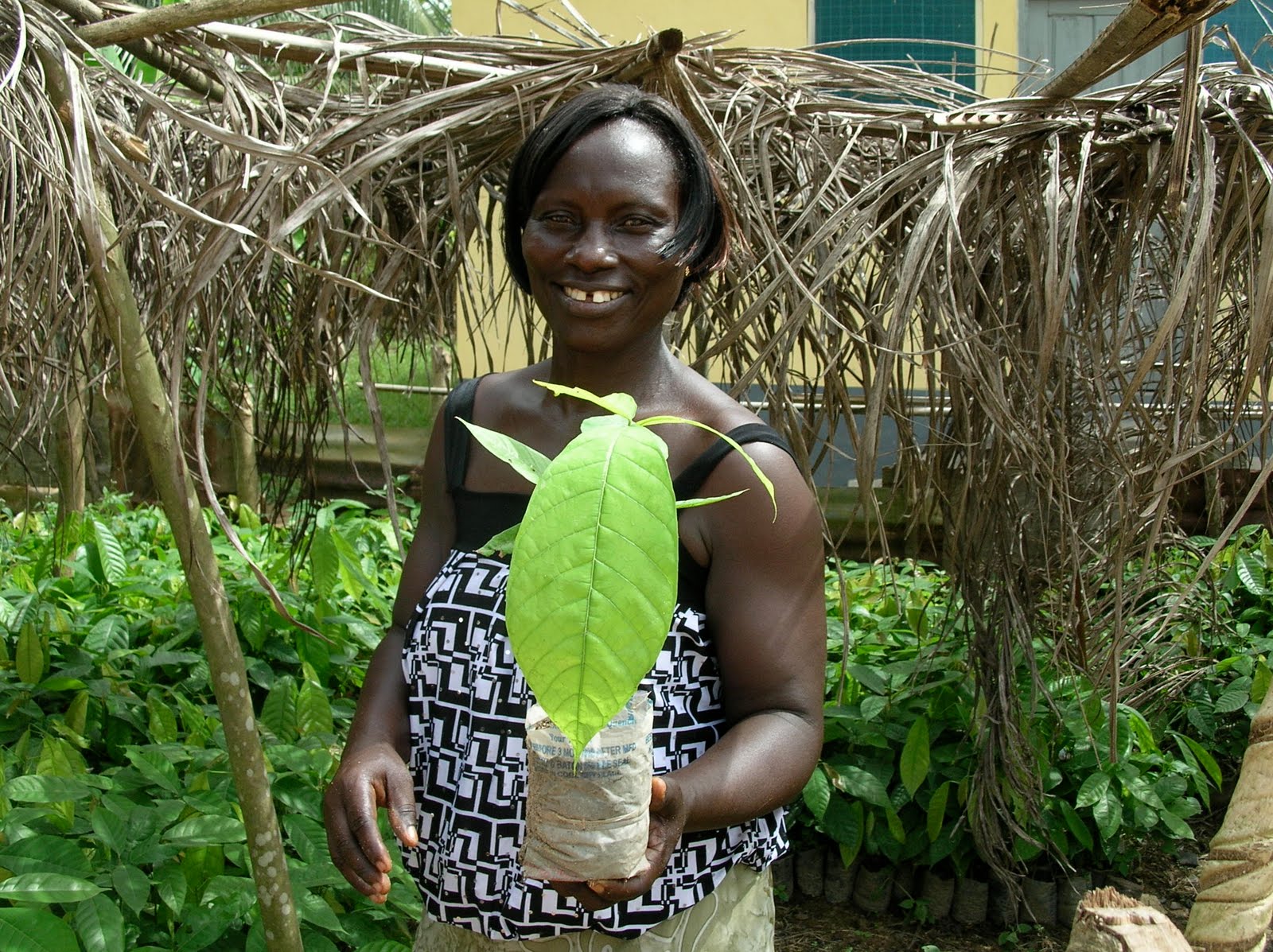
On March 30, we went to visit Jennifer, DeeDub's home-stay mother. When DeeDub first came to Ghana, she went to stay with a family for a period of time. Jennifer, pictured left, is a school teacher and lives with her extended family in a matriarchal compound. Below is Jennifer's mother and her daughter, Patience. Another daughter, Faustina, is trying to get into nursing school. Jennifer is very entrepreneurial and is growing cocoa plants to sell. She also raises chickens.

The compound is made up of several buildings surrounding a central area (shown to the right). Patience is ill and has lost an enormous amount of weight. Doctors have not yet been able to diagnose her illness, but Jennifer has prepared a herbal root and dried cassava to help treat her.


We stayed for a short visit and then caught a taxi back to Osien, where DeeDub was trying to see Madame Teresa about providing pizza for a girl's camp DeeDub is planning. Madame Teresa was not there, but it starting pouring rain, so we decided to share a beer and wait it out before catching a Tro back to Adjeikrom.


On the morning of March 31, we ran out of propane. DeeDub had been hearing that there was a significant shortage of propane and that people were having a hard time getting it. Osa came and took DeeDub's tank and the tank from the kitchen building and embarked on the project of trying to find some. DeeDub had to give him travel money (Tros and/or taxis) in addition to money for the propane so he could travel around on his search.
In the meantime, we set out to go to a dedication of a new kindergarten building that a couple of Peace Corps volunteers had built (both by raising money and through their labor). This couple, Marian and Alan Ruge, are stationed in Brekumanso and the school is in KwakuSae. We caught a Tro from Adjeikrom to Koforidua, where we changed to a Tro going to Asamankese. After a lot of confusion regarding how to pronounce the names of the various destinations, we were let off at the junction to KwakuSae. We then started hiking up the dirt road (in the noon-day sun, of course) to the school. I think we walked a good 20 minutes before I started hearing drums in the distance. We were quite relieved when the Peace Corps Country Director, Mike, and his driver, Kofi, stopped and picked us up to drive us the rest of the way. Whew! Air conditioned splendor!
There were quite a few people there singing and dancing. The building in the background of the first shot is the existing school building. The second picture is the new kindergarten building.


We retired to the room on the far right and had meat patties and soft drinks. The event was starting much later than originally planned because the dignitaries were late in arriving. One group was from the Presbyterian Church. Apparently the school was founded by Presbyterians. Below are some women wearing fabric that commemorates their church. Apparently it is quite common for the "church ladies" to have clothes made of fabric made to order by churches.

Once they arrived, there was a series of speeches, all of which were quite moving. Everyone praised Marian and Alan for their dedication and very hard work and encouraged residents to continue to support improvements to the school system. They even got the main political figure that was there to commit to providing computers!
Mike and his driver gave us a ride to Koforidua, where we spent the night at the "Partners May" hotel. What a trip!

We went to the restaurant and asked if they had white wine. All they had that was anything close was warm champagne. We then asked if they had gin and tonic. The man said he'd have to call the bar. So, we walked to the bar which was down the driveway, close to the road. A young woman was finally able to serve us each a jigger of dry gin (they don't know what gin is) and a bottle of fruit juice (no ice). We enjoyed it! DeeDub went back up to the restaurant and got a menu so we could decide what we wanted and allow plenty of time for food preparation. She very wisely suggested that we choose backups as it turned out all of our choices were "finished." The only thing available was fried fish (tilapia), which turned out to be quite tasty. It was a challenge eating though, since we decided to eat outside at the bar and there was no light. Picking around the fish heads and bones was slow going, but it was good.
The morning of April 1, we went downstairs and had the breakfast before taking a cab into the part of Koforidua near the Krobodan Internet Cafe. Kathryn, a Peace Corps volunteer, has an office at this facility. In addition to the internet cafe project, this organization (Dutch, I think) has women who make jewelry. There are tons of non-profit organizations that are set up to help Ghana develop. Volunteers come from all over the world, not just the Peace Corps.

We met Rebecca (another Peace Corps volunteer) at the internet cafe and she took me to the bead market. Rebecca also works with women who make and sell beads. Anyway, her assistance was great and I was able to buy lots of beautiful beads at a very reasonable price. She's a monster bargainer!

Rebecca also helped me buy some beautiful fabric.
Later, after we returned to the internet cafe and met Kathryn, the four of us went to lunch.

These women are great (Kathryn left, DeeDub and Rebecca right)! They provide enormous support for each other: exchanging magazines, picking up mail in Accra for each other, and texting each other to exchange ideas. Although they are stationed in different villages, they get together periodically. Neat!
Ann's Visit to Ghana: Bosuso

On March 28, the day after the engagement ceremony, we went to the Wedding Blessing in Bosuso. Again, Patience came to escort us to the event. We walked down the main street to the area where taxis, Tros and busses stop and caught a taxi to the neighboring village. The blessing, by three different clergymen, took place in an Apostolic Church. We were given front row seats, so had an excellent view of the entire ceremony.
The ceremony itself was very much like an American church wedding: the bride is lead down the center aisle by her father and turned over to the groom and they exchange vows and rings. Again, I was able to understand very little of what was said, but because the various aspects of the ceremony were familiar, because some English words were used, and because I had Patience to explain to me what was going on, this ceremony was a little more like home. This is a picture of Mary, Richard, and Mary's father.

Aside from three different clergymen being involved in the ceremony, there were some other unique characteristics. The most remarkable was a series (three, I think it was) of people parading up to put money in a box for the bride and groom.
The people sing and dance throughout these offerings and other parts of the ceremony. The excitement generated by their energy and joy was really quite remarkable and at one point I felt absolutely dizzy. Of course it was hot and humid, but that couldn't account for my heart beating so wildly.

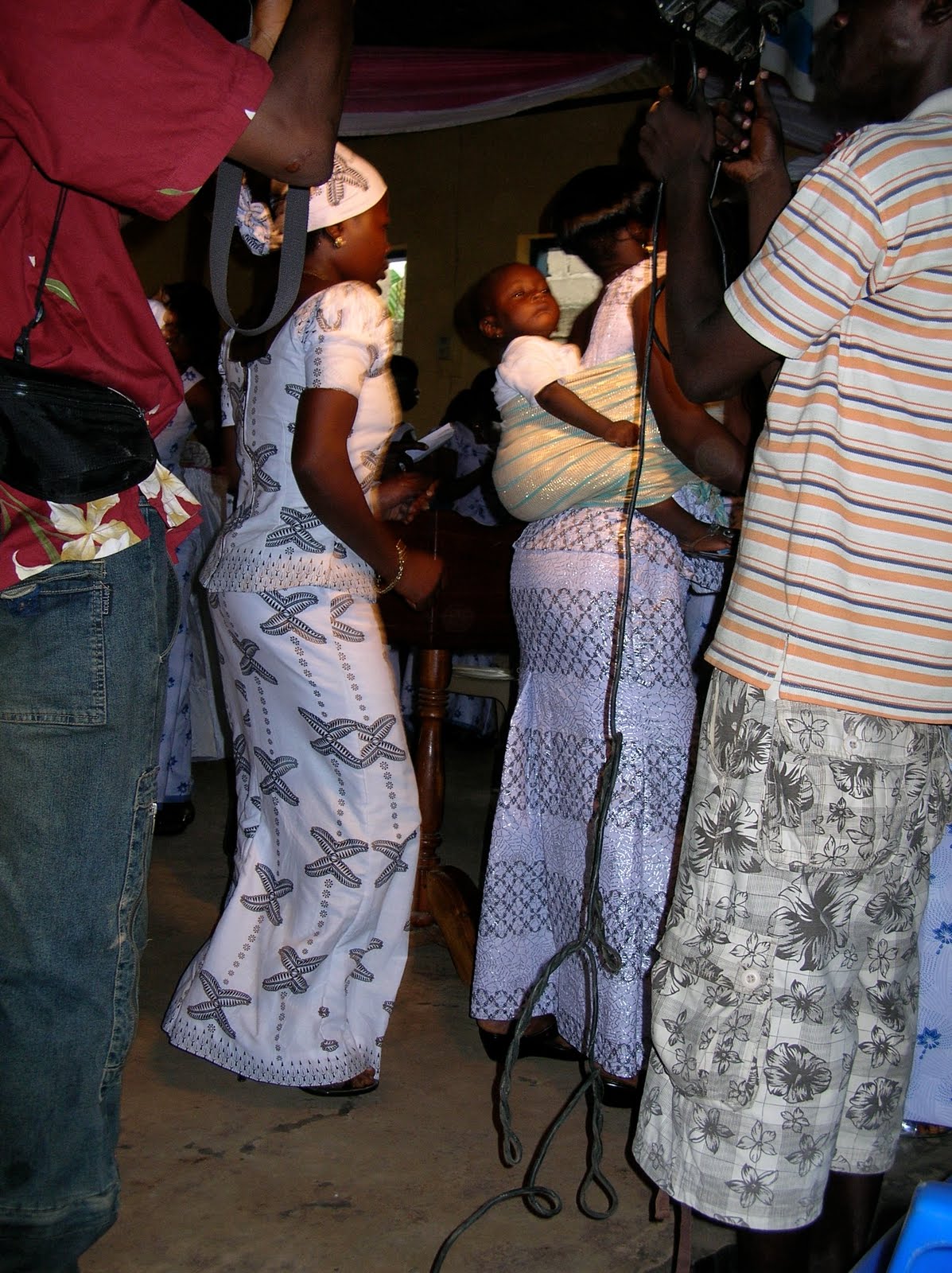
You can get a better sense of how exhilarating it all was by watching my video of the blessing ceremony on YouTube: http://www.youtube.com/watch?v=vlWr8C7s3cE.
 The picture above is of Patience; Dorothy's Peace Corp counterpart, Osa; and our wonderful DeeDub, more commonly known in Ghana as Mama Dee. It was taken outside the church after the ceremony. by the way, it appears that sometimes you can click on the photographs to see an enlargement. I can't figure out why it doesn't always work.

Thursday, April 22, 2010
Ann's Visit to Ghana: Adjeikrom
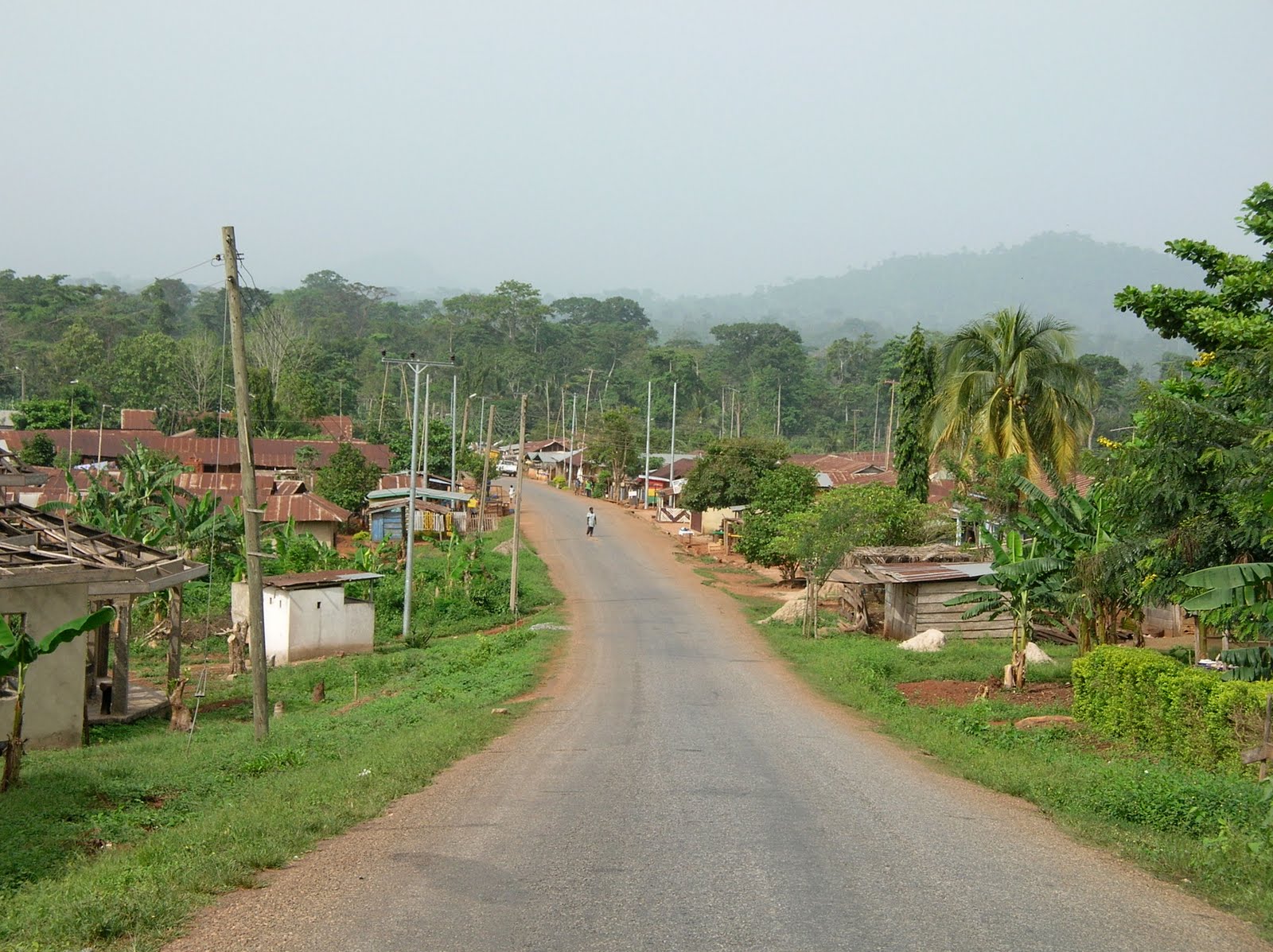
The village where Dorothy lives and works does not appear on any map I've been able to find. Adjeikrom is northwest of Koforidua, which is almost directly north of Accra. Dorothy is currently involved in compiling a census of the village; no one really knows how many people live there. There is one main road through town. The picture to the left is taken from the north end of town, near the guest house where Dorothy lives.
The guest house was built by Cadbury and is part of a campus that includes a visitors' center, a screened canteen, a kitchen building, a four-shower bath structure, two latrines, and a large yard. I have posted a video of where Dorothy lives on YouTube:http://www.youtube.com/watch?v=7hjL9Sj6vVY


This is Dorothy standing outside the two rooms in the guest house that she lives in. One room is her bedroom and the other is a living area that includes a cooking area, a desk, a single bed/couch, and a couple of chairs.
We were very fortunate to be invited to a couple of events: a traditional engagement ceremony and a wedding blessing for Mary Tetteh and Richard Narketey. The engagement ceremony took place at Mary's father's house in Adjeikrom on . Patience (a young woman who sometimes works for Dorothy) came to escort us to the engagement ceremony. We walked down the main road and then walked off to the right between several mud buildings. The ceremony actually took place between several buildings, under canvas canopies that had been set up. When we arrived there were already many people there. There were two groups facing each other. One group was the bride's guests and the other was the groom's guests. I estimate there were more than a hundred people in all.

We were very fortunate to be invited to a couple of events: a traditional engagement ceremony and a wedding blessing for Mary Tetteh and Richard Narketey. The engagement ceremony took place at Mary's father's house in Adjeikrom on . Patience (a young woman who sometimes works for Dorothy) came to escort us to the engagement ceremony. We walked down the main road and then walked off to the right between several mud buildings. The ceremony actually took place between several buildings, under canvas canopies that had been set up. When we arrived there were already many people there. There were two groups facing each other. One group was the bride's guests and the other was the groom's guests. I estimate there were more than a hundred people in all.
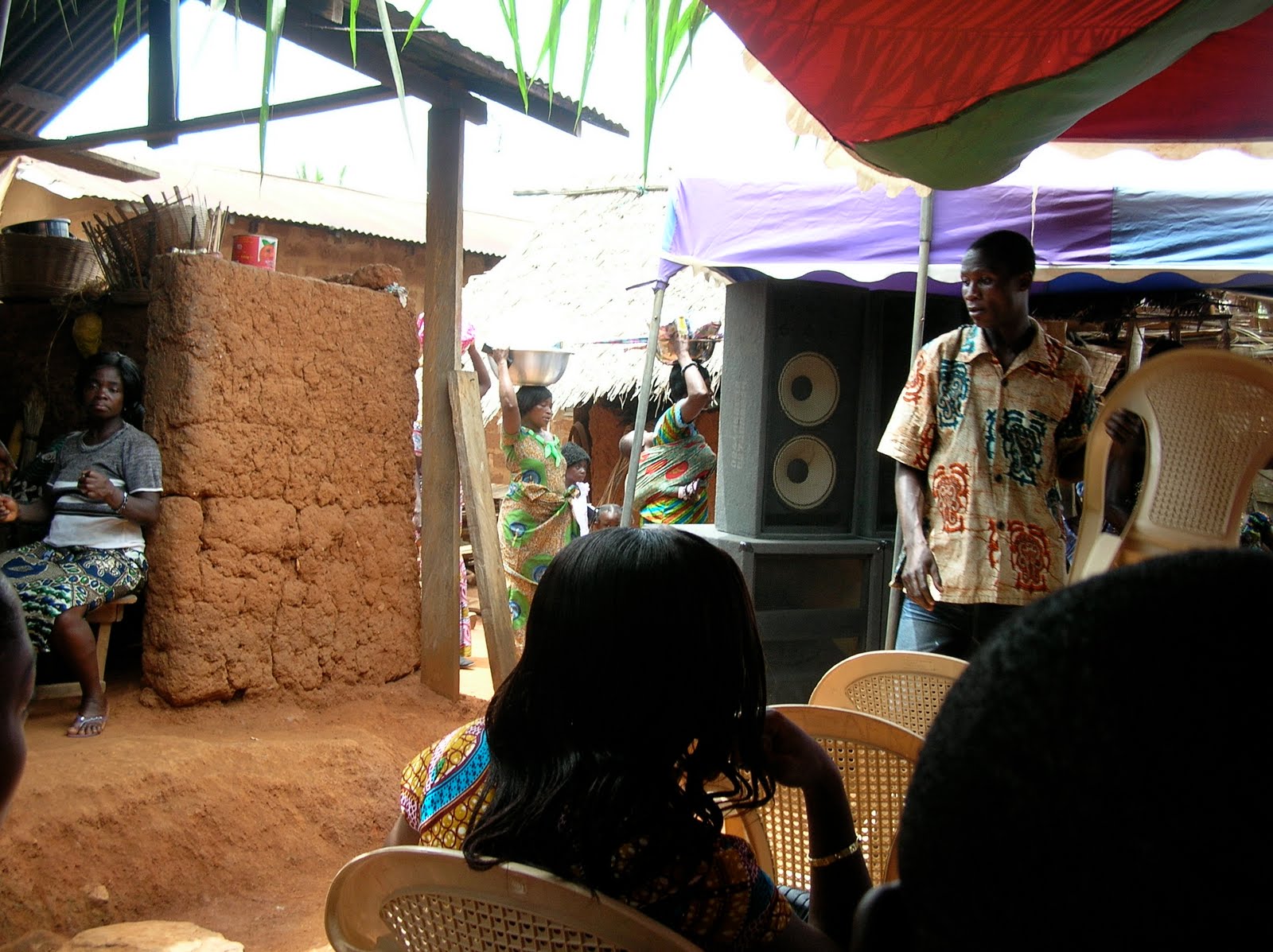


Soon after we arrived, a "door-knocking" ceremony began. This involved many of the groom's family/guests asking permission to enter and present gifts to the bride's family. I have posted a video of the engagement ceremony at : http://www.youtube.com/watch?v=69xs5sP6eEA
Because the ceremony was not in English, I had to rely on what Patience told us about what was going on. The ceremony involves a lot of negotiation and numerous appearances of the bride in different outfits. I noticed that the bride's hair arrangement changed with each outfit, but I don't know if there was any significance to that. The negotiations appeared to concern "bride price" or what the groom's family was offering to give the bride's family for the couple's wedding. At one point representatives from both families retire to a building where they apparently "audit" what the groom's family is giving. During another part of the ceremony, several women get up and sing to the groom's family a song that apparently questions how the groom will "perform" as a husband.
After the families arrive at an agreement, Mary looks for her husband to be. She obviously knows that he is there, but at this point he is hidden behind a cloth. As you can see by watching the video, everyone is obviously very amused by this trick.
The last part of the video shows Mary presenting a "libation" to her father. Her father asks her if he should accept the libation. By telling him to accept it, she is telling him that she wants to marry Richard.
The ceremony that day was an abbreviated version of the truly traditional ceremony that apparently can last a very long time. This version lasted 3 or 4 hours and was actually interrupted by a rain storm that filled the canopies and flooded the packed mud floor. The ceremony was then moved to the chief's palace. Dorothy & I went back to her place because Kate and Tony (teachers from Tafo) came to exchange books with Dorothy.
Wednesday, April 21, 2010
Ann's Visit to Ghana: Accra
I flew into Accra from Sacramento on March 24. Dorothy checked into our room at the Afia Beach Hotel early and rode with the hotel's driver to the airport to meet me. The hotel was modestly priced, quite comfortable, and within easy walking distance of the National Cultural Center (a huge craft market). I was overwhelmed with the heat and humidity so was quite pleased that we could return to an air conditioned room after changing money and getting lost in the craft market.

Osa, Dorothy's Peace Corps counterpart from Adjeikrom (Odd-jay-chrome) came to Accra on my third morning there to help us get all of our luggage (and us) back to Adjeikrom.

Osa went with us to find a coffin-carver studio that Dorothy had read about and the Artists' Alliance Gallery on Labadi Road. We went to the gallery first and it was quite good with a beautiful, large collection of art and crafts, including some beautiful examples of the exotic coffins. Unfortunately, the gallery does not permit photographs. But, these coffins are amazing. They come in a variety of forms: a large red fish, an airplane, a small lion, etc. I was able to take a couple of pictures of coffins that were on the second floor of the carvers' studio.


At the end of the trip, we returned to Accra for my departure back to the US. This time we stayed at Beachcomber Guesthouse in Nungua. This was less expensive than the Afia and quite nice.


Osa, Dorothy's Peace Corps counterpart from Adjeikrom (Odd-jay-chrome) came to Accra on my third morning there to help us get all of our luggage (and us) back to Adjeikrom.

Osa went with us to find a coffin-carver studio that Dorothy had read about and the Artists' Alliance Gallery on Labadi Road. We went to the gallery first and it was quite good with a beautiful, large collection of art and crafts, including some beautiful examples of the exotic coffins. Unfortunately, the gallery does not permit photographs. But, these coffins are amazing. They come in a variety of forms: a large red fish, an airplane, a small lion, etc. I was able to take a couple of pictures of coffins that were on the second floor of the carvers' studio.


One of the featured artists at the gallery is Ablade Glover. Here is a link to a site that shows some of his work: http://www.google.com/imgres?imgurl=http://www.octobergallery.co.uk/images/760x570/glover_red_market2.jpg&imgrefurl=http://www.octobergallery.co.uk/exhibitions/2009glo/index.shtml&h=507&w=760&sz=285&tbnid=RX7PxwiAeGH7WM:&tbnh=95&tbnw=142&prev=/images%3Fq%3Dablade%2Bglover&usg=__UFSPwE0wrRUMtKm0NQ5HDrvN9yA=&ei=kUnQS8F9h5yyA43ayK4P&sa=X&oi=image_result&resnum=9&ct=image&ved=0CBwQ9QEwCA

After checking out of the hotel, we took a cab through the streets of Accra to the station where we would catch a Tro that would take us to Adjeikrom.

As Dorothy described in an earlier posting, Tros are vans that provide transportation throughout Ghana. They are typically packed with passengers and the back door must be tied shut to hold all of the luggage and products being transported. The station was wild: lots of people carrying a huge variety of wares on their heads. Everything from pure water in small plastic satchets, to food, to sandals, to toothpaste. It was total chaos.


If you are interested, I have posted a video of Accra at http://www.youtube.com/watch?v=frcOsR9_yrs
At the end of the trip, we returned to Accra for my departure back to the US. This time we stayed at Beachcomber Guesthouse in Nungua. This was less expensive than the Afia and quite nice.


I would recommend both of these hotels. However, the Afia had the distinct advantage of having cold white wine available at the bar!
Ann Campbell
Thursday, April 1, 2010
Light at the end of the tunnel.
April 1, 2010. Just a quick update, and I think I may have sounded more morose than I actually felt. A friend from home is visiting me, and it is just wonderful. Also, the projects are taking hold. So here's a brief review. 28 kids showed up for the English club, and didn't even have to be bribed. I'm thinking of word games we can play, and they had a spelling bee that was a lot of fun. More later.
The grant money that we did get includes funds to drill a new borehole on campus, with an electric pump that would fill both polytanks. They are now filled by women, one bucket at a time, from a borehole about half a mile away. One tank will flush the toilets in the visitor center, and the other will provide water for the kitchen and have a standpipe close to the gueshouse. My house water, stored in a large garbage can, now is filled separately but from the far borehole. So we are getting bids for the work, and it's pretty fun. Apparently old ladies, or women of any age, don't ask questions like:
What size pump? What's the hp? How deep will you drill, and what kind of guarantee will we have that the hole won' t dry up three months later? The first bid we got was like 6800 ghana cedis for drilling, 500 for development, and 200 for plumbing. When I asked the director what he meant by development, and what size pipe he would use for the plumbing, he hung up on me. So I am seeking new bids now, and have talked with a couple of guys that seem really promising. One says they will drill through bedrock to deliver *ancient water*, and the other says at least 300 feet. The members of the committee were as shocked as I was that the first bid refused to provide any real information, and each said (with no prompting from me) that it was totally unacceptable.
I am also working with the pastors of four churches in the village, three of which do not have electricity. For one Sunday a month we will ask each member of the congregation to contribute one cedi to the electricity fund. I also had a census done, and just got the results. Five men in the village went to every household and asked how many adults, how many kids and what age, do they go to school, and whether there is light in the house. I am trying to put it all into an Excel spreadsheet, and use the information to convince the District Assembly that they should help. Then I can show that X number of kids in this village don't have electricity at home, that the two schools do not have electricity so kids can't learn computer skills or study at home, etc. Everybody is excited about that, because we don't even know how many people live here, and they are checking with me to be sure they got included, etc. We will try to raise the money locally, and try for matching funds from the government and/or with an NGO. I want it to be THEIR project, not mine, and not just so the white lady can have electricity in her quarters. It requires a lot of money from people where the minimum wage is 3 cedis a day, but people are working together to see it happen.
A friend lives close to a church that often has all-night services, and she reminds me that as soon as they have power the two churches across the road from me will install amplifiers, but I'll deal with that when the time comes. In either event I'll be ready to go home by the time we get this done, but I'm not leaving yet.
The grant money that we did get includes funds to drill a new borehole on campus, with an electric pump that would fill both polytanks. They are now filled by women, one bucket at a time, from a borehole about half a mile away. One tank will flush the toilets in the visitor center, and the other will provide water for the kitchen and have a standpipe close to the gueshouse. My house water, stored in a large garbage can, now is filled separately but from the far borehole. So we are getting bids for the work, and it's pretty fun. Apparently old ladies, or women of any age, don't ask questions like:
What size pump? What's the hp? How deep will you drill, and what kind of guarantee will we have that the hole won' t dry up three months later? The first bid we got was like 6800 ghana cedis for drilling, 500 for development, and 200 for plumbing. When I asked the director what he meant by development, and what size pipe he would use for the plumbing, he hung up on me. So I am seeking new bids now, and have talked with a couple of guys that seem really promising. One says they will drill through bedrock to deliver *ancient water*, and the other says at least 300 feet. The members of the committee were as shocked as I was that the first bid refused to provide any real information, and each said (with no prompting from me) that it was totally unacceptable.
I am also working with the pastors of four churches in the village, three of which do not have electricity. For one Sunday a month we will ask each member of the congregation to contribute one cedi to the electricity fund. I also had a census done, and just got the results. Five men in the village went to every household and asked how many adults, how many kids and what age, do they go to school, and whether there is light in the house. I am trying to put it all into an Excel spreadsheet, and use the information to convince the District Assembly that they should help. Then I can show that X number of kids in this village don't have electricity at home, that the two schools do not have electricity so kids can't learn computer skills or study at home, etc. Everybody is excited about that, because we don't even know how many people live here, and they are checking with me to be sure they got included, etc. We will try to raise the money locally, and try for matching funds from the government and/or with an NGO. I want it to be THEIR project, not mine, and not just so the white lady can have electricity in her quarters. It requires a lot of money from people where the minimum wage is 3 cedis a day, but people are working together to see it happen.
A friend lives close to a church that often has all-night services, and she reminds me that as soon as they have power the two churches across the road from me will install amplifiers, but I'll deal with that when the time comes. In either event I'll be ready to go home by the time we get this done, but I'm not leaving yet.
Subscribe to:
Posts (Atom)